G is for Grouper

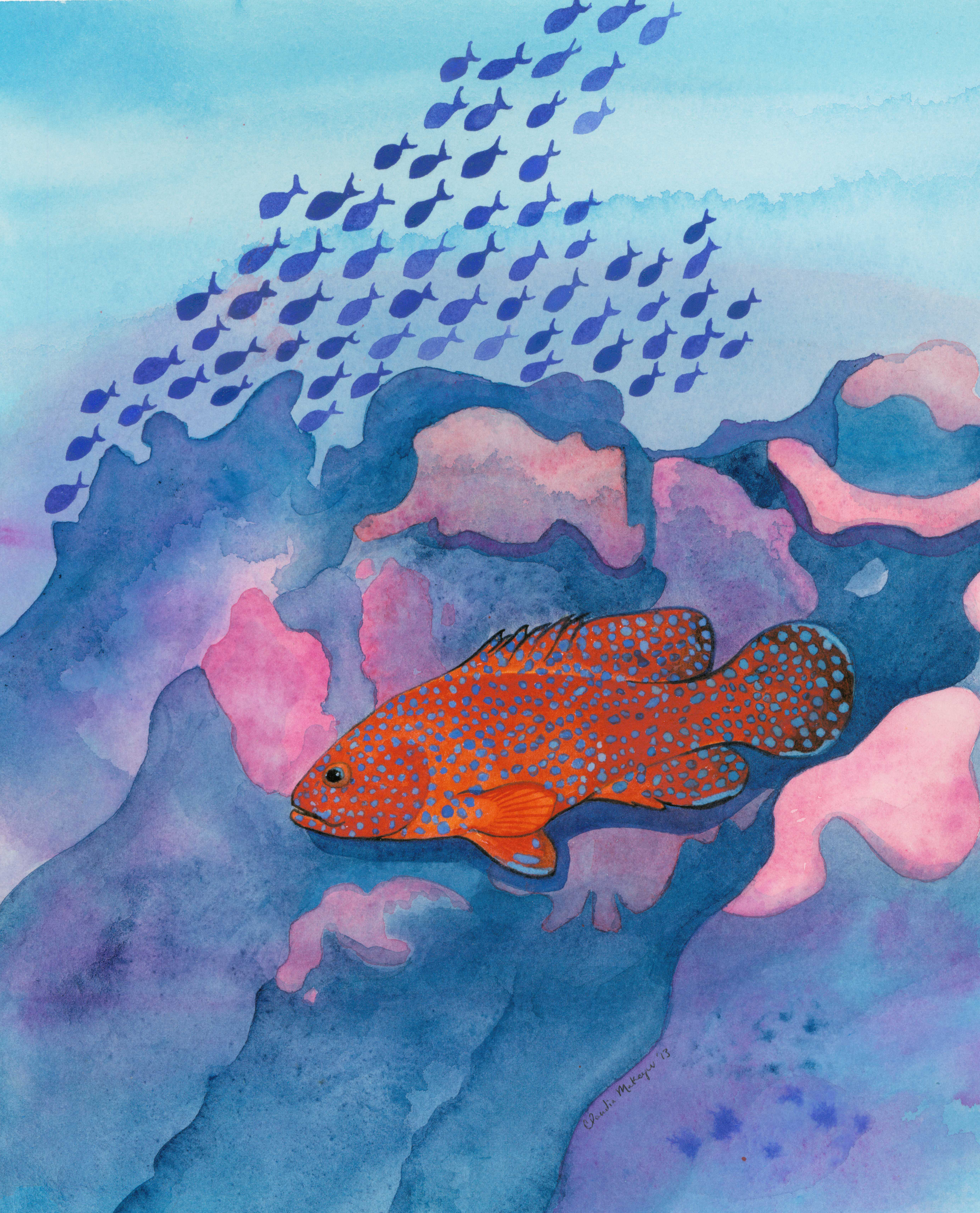
Coral Grouper
Lapu Lapu

The Coral Grouper

Tagalog: Lapu Lapu

Scientific name:  Cephalopholis miniata

The Grouper is a cruiser.

Her job is to patrol, ponder and protect her piece of reef from other big predators. Her flashy colors won’t betray her. The deeper she patrols away from the sunlight, the more her brilliant red fades away, blending her into this homey reef background until she is almost invisible.  This is perfect for sneaking up on intruders or surprising tasty unsuspecting morsels.
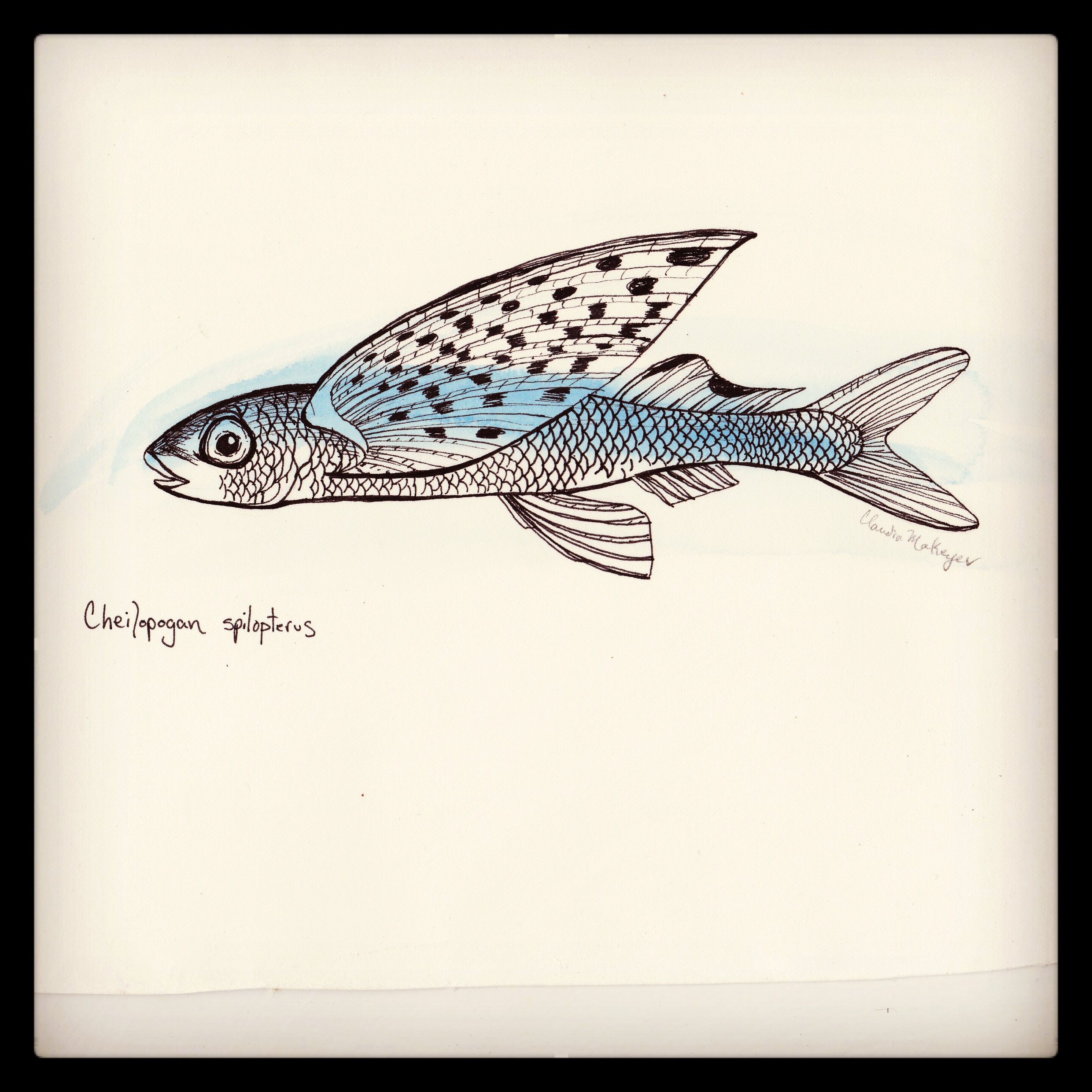
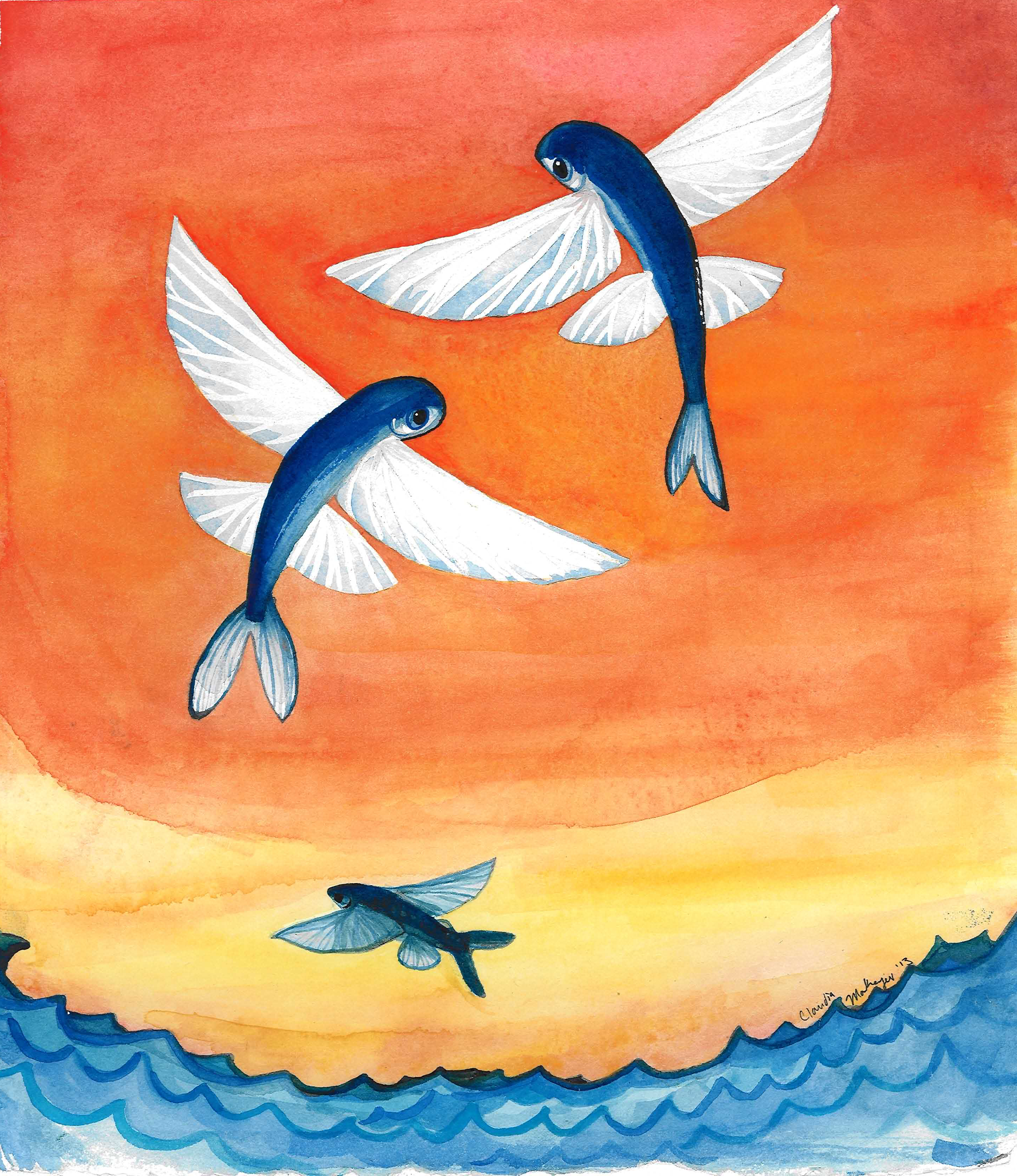
F is for Flying Fish Fins

Cheilopogon spilopterus- flying fish

flying fish watercolor by Claudia Makeyev

These far out pectoral fins are actually wings

F is for Flying Fish Fins

Tagalog: Isdang lawin

Scientific name: Cheilopogon arcticeps

Flying fish pectoral fins make fantastic wings. With these fins, one can jump out of the water to enjoy the thrill of flying on the salty sea air.  The use of these fins is a fast way to elude feisty flying fish loving predators.  There is nothing more satisfying for a full fledged flying fish than keeping pace with the flying fish school and frolicking on ocean currents of both air and water. There are few fishes in the ocean that have the fins to enjoy this type of freedom.

Garrison Keeler just read this poem and, trees aside, it felt like flying fish to me:

Flying

by Richard Wilbur

Treetops are not so high
Nor I so low
That I don’t instinctively know
How it would be to fly

Through gaps that the wind makes, when
The leaves arouse
And there is a lifting of boughs
That settle and lift again.

Whatever my kind may be,
It is not absurd
To confuse myself with a bird
For the space of a reverie:

My species never flew,
But I somehow know
It is something that long ago
I almost adapted to.

“Flying” by Richard Wilbur, from Anterooms. © Houghton Mifflin, 2010.

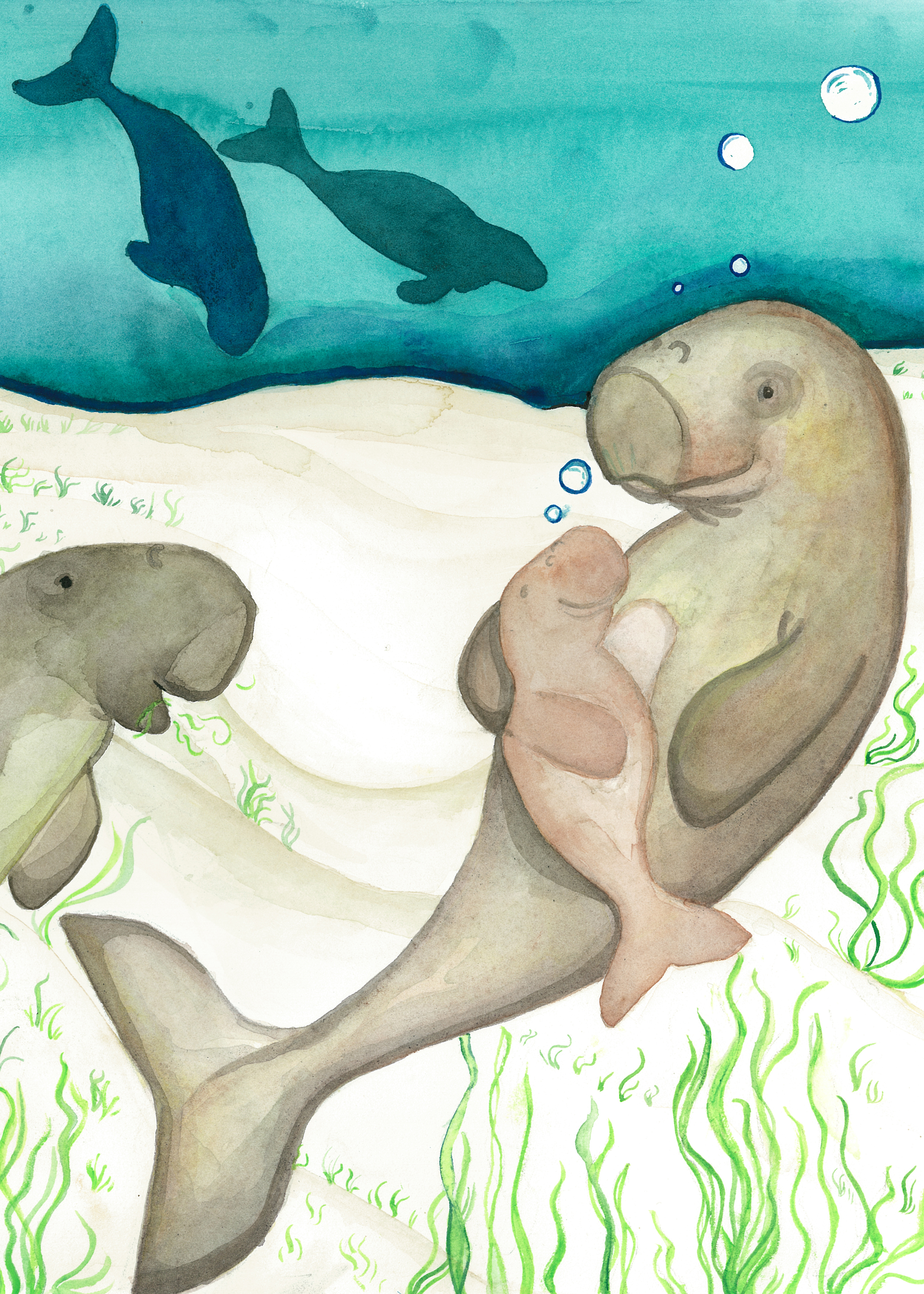
D is for Dugong

Dugongs
D is for Dugong
a water color by Claudia Makeyev

D is for Dugong

Tagalog: Duyong

Scientific name: Dugong dugon

We delight in devouring delicious, delicate sea grass shoots.

We’re shaped like manatees and have dolphin tails to boot
Underwater we swim, sleep, and eat but we are not fish.

Dugongs are actually mammals, Isn’t that neat?

C is for Colorful Coral Creatures

red coral
C is for Colorful Coral Creatures
A Watercolor
by Claudia Makeyev

Tagalog: Gasung

Scientific name: Corallium spp.

We all live attached together underneath the big blue sea.

Up close we each resemble an itty bitty Anemone.

Call us Coral

B is for Brown Banded Bamboo Shark

water color by claudia makeyev
Brown Banded Bamboo Shark
by Claudia Makeyev

The Baby Brown Banded Bamboo Shark likes stripes.

Stripes, like those of the poisonous sea snake, fool potential predators (the dumb ones) and protect this baby from being eaten.

When the Brown Banded Bamboo Shark grows out of his juvenile stripes, he becomes a mature brown.

Unfortunately, most humans are not fooled by the stripes and these little guys are commonly eaten in the islands of The Coral Triangle.


Boding = Tagbanua/Tagalog name for Shark

A is for Anemone

Anemone watercolor
A is for Anemone
~by Claudia Makeyev

I am an Anemone,

A tentacled beast at the bottom of the sea.

It is a beautiful place with a lot of space,

And it used to get quite lonely.

One day a clownfish and some Zooxanthelae

floated by, nestled in and came to live with me.

We are now a happy, multi-species family.

The Anemone, the Clownfish and the Zooxanthellae are a symbiotic threesome found all over the reefs of Palawan.

The Mermaid Islands Corp is coming out with a fun fact filled Alphabet book of the sea creatures we have found in Palawan. Bright watercolors and ocean critter stories promise to be entertaining to mermaids and kids alike. Enjoy these teasers and stay tuned for more updates on how to reserve your book.

Banan = Tagalog/Tagbanua name for Anemone

Dugongs like Surfboards

Dugongs
Dugongs, a water color by Claudia Makeyev

These gentle “sea cows” share the Order Sirenia (mermaid) with manatees. They graze in the underwater meadows of tropical sea grasses but are not complete vegetarians. Every once in awhile, they munch on a slow moving jellyfish, polychete worm, or sea squirt.

I discovered that the shy curious Dugong is attracted to surfboards. There is a nice little right point break near… (nope, not telling, he he he), where Dugongs pop their big noses out of the water, investigating you and the surfboard’s dugong-like silhouette. Gentle, graceful marine mammals, it IS like meeting a mermaid.

They are traditionally eaten in this area but are now protected. Being endangered and charismatic aquatic mammals, they bring significant tourist dollars to Busuanga. 30+ Dugongs now swim in the waters around northern Palawan and this year there were 3 calves.

Purple Parrotfish

Scarus niger ~Watercolor by Claudia Makeyev

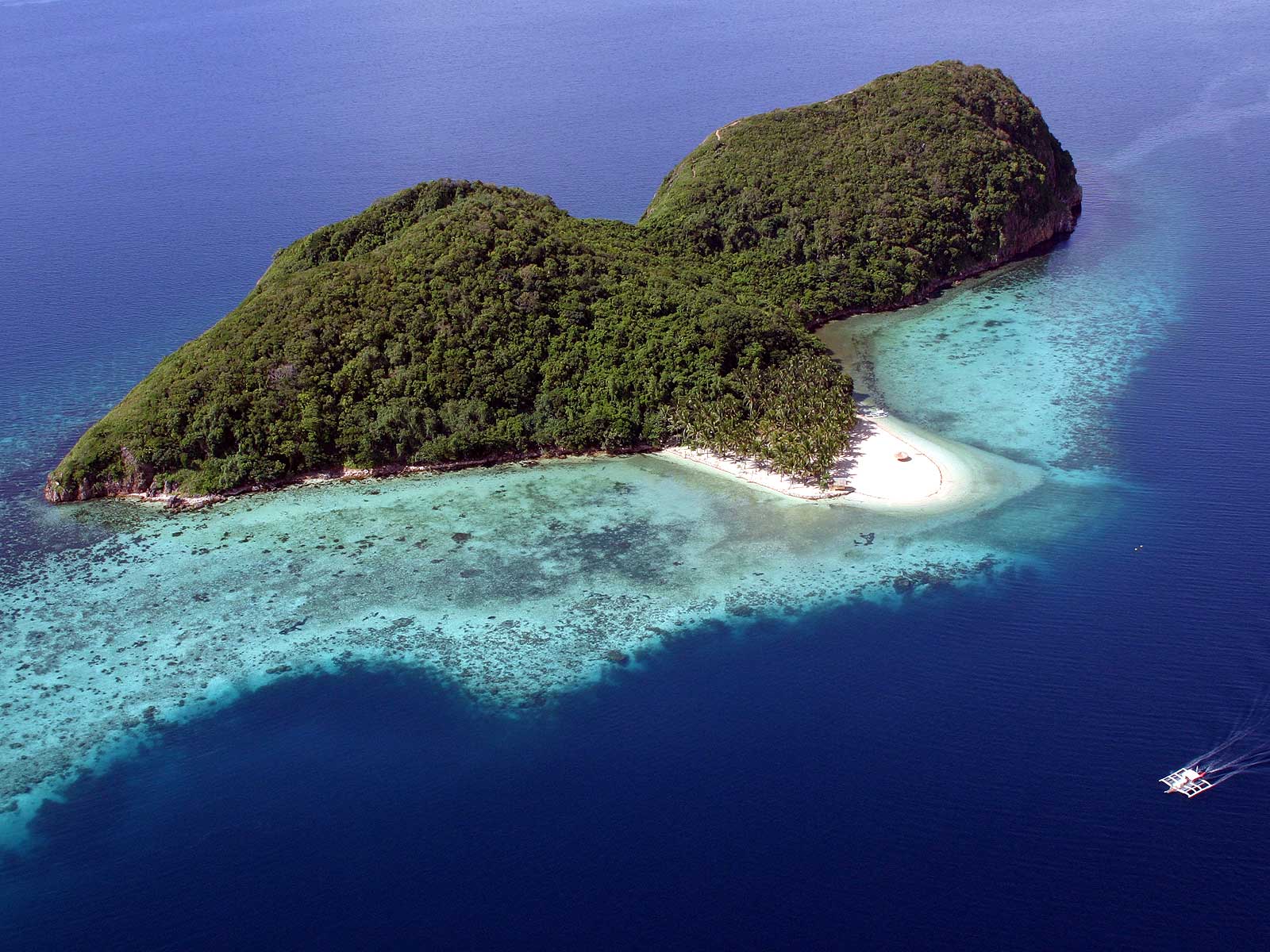
Parrotfish, known as Mol Mol in Palawan, are the creators of the beautiful tropical white sand beaches. They are particularly fond of eating the algae film that grows on coral. They chomp into the coral with their beak (actually fused teeth) to get a mouthful of both coral and algae. The crushed coral helps the fish digest the algae and is then pooped out in the form of particularly perfect, soft, white sand. Next time you are relaxing on your tropical vacation, please thank the parrotfish.

These particularly pretty purple parrotfish look most like the male Swarthy Parrotfish – Scarus niger. The ones observed here have slightly different spot patterns behind the eyes but it could be a local variation or due to a shift between initial and terminal phases.

That is A LOT of beautiful tropical white parrotfish poop. Enjoy!